Bluejoint Reed Grass
Calamagrostis canadensis
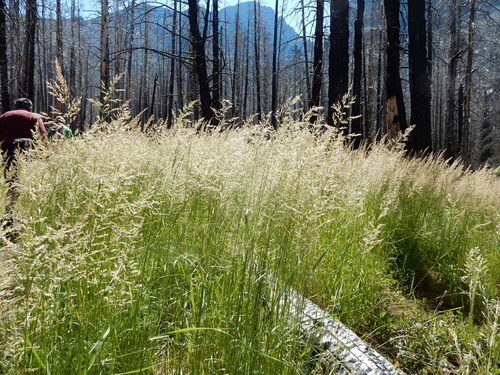
(c) Matt Lavin, some rights reserved (CC BY)
Growing it
| When | Flowers June to August; fruits August to September |
|---|---|
| Type | grass |
| Sun | Full sun, partial shade |
| Water | Medium, high |
| Soil | pH 5.5–7 |
| Hardiness | zone 2–7 |
| Mature height | 1.5 m |
| Mature spread | 0.9 m |
| Spacing | 0.6 m |
| Years to maturity | 2 |
| Bloom | Jun–Aug |
| Flower colour | Straw / green (grasses & sedges) wind-pollinated, so no showy flower |
| In bloom | June July August |
| Fruit | Aug–Sep |
| Native to | AB, SK |
narrow linear leaves about 30 cm long
Where it has been recorded
Which ecoregions the records fall in
- Eastern Continental Ranges central AB: 57 records, high confidence
- Boreal Transition central AB / SK: 50 records, high confidence
- Aspen Parkland central AB / SK: 49 records, high confidence
- Mid-Boreal Uplands central AB / SK: 47 records, high confidence
- Western Alberta Upland central AB: 30 records, high confidence
- Slave River Lowland north AB: 23 records, high confidence
- Northern Continental Divide south AB: 21 records, high confidence
- Churchill River Upland north SK: 17 records, medium confidence
- Peace Lowland north AB: 15 records, medium confidence
- Tazin Lake Upland north AB / SK: 15 records, medium confidence
- Hay River Lowland north AB: 12 records, medium confidence
- Athabasca Plain north AB / SK: 10 records, medium confidence
- Fescue Grassland south AB: 6 records, low confidence
- Selwyn Lake Upland north SK: 5 records, low confidence
- Wabasca Lowland north AB: 5 records, low confidence
- Moist Mixed Grassland south AB / SK: 3 records, low confidence
- Western Boreal central AB: 3 records, low confidence
These are counts of records collected somewhere in the region, which is the resolution of the evidence: the map above shows where inside it. A region with 3 records is not the same claim as one with three hundred, so the count travels with the region. A region missing from this list means nobody has recorded it there, which is not the same as the plant being absent. Records within 900 m of a border count for neither side, because the border is not drawn finely enough to say which one they are on. Source: GBIF occurrence search + PRESERVED_SPECIMEN pass, retrieved 2026-08-24. Boundaries digitised from the National Ecological Framework for Canada v2.2 (Ecological Stratification Working Group 1995), simplified to about 900 m for display: an outline is accurate to roughly a kilometre, not to the metre. How these counts are made.
See every observation, live and current, on GBIF or iNaturalist.
Documented animals
No animal relationships are documented for this species in our sources. That is a gap in the catalogue, not evidence that nothing uses it.
Also worth knowing
Safety
Toxicity not assessed, absence of a warning is not a guarantee of safety
Buying it
About $8–$16 per plant (estimate), usually sold as seed or plugs. Estimate (grass default); AB retail as of 2026